
Crawl of the Forsaken graphics update: what the melted monsters look like from the gameplay camera
· 8 min read
By Phil · building Legitsauce
A couple of weeks ago I wrote up how the Crawl of the Forsaken monsters got rebuilt on signed distance fields: continuous bodies sculpted in code, fused into one skin with a smooth-union, then baked down to small meshes a phone can run. That post showed the technique with clean studio renders, one creature at a time, lit to flatter it.
This is the progress report. Since then the conversion has moved from three creatures to most of the roster, including the bosses and the whole robed-caster wing of the bestiary. And this time I want to show it honestly, so every comparison below is shot through the actual gameplay camera. Same top-down angle, same dungeon torchlight, same distance you see a monster at when it is trying to kill you.
Why the gameplay camera is the only test that counts
A close studio render flatters everything. Put a monster two feet from the lens under a soft key light and even a rough one looks fine. Then the real game drops it into a dark room, forty feet under a camera tilted sixty degrees toward the floor, and half of what you tuned up close disappears.
So a design has two jobs, and they pull against each other. It has to hold up when a curious player walks right up to it, and it has to still read as itself when it is a two-inch shape in the corner of a phone screen. A lot of the work in this batch was closing the gap between those two views. Here is an early monster you have probably fought, the crypt ghoul, at the scale you actually meet it.
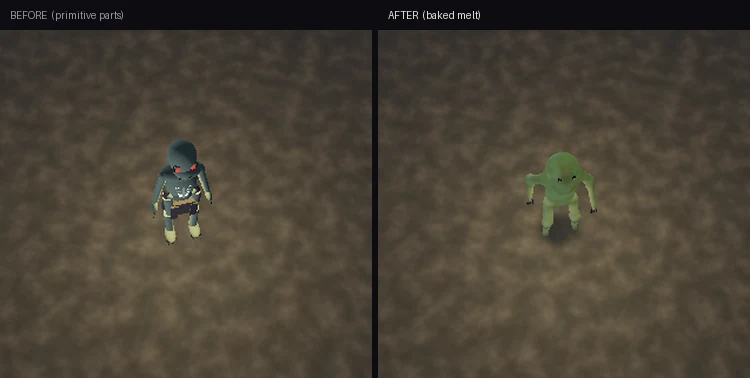
The old ghoul is not terrible at this size. It is just clearly a set of parts that agreed to stand near each other. The melted one reads as a body. The difference that does the most work here is lighting: the old monsters ignored the scene entirely and glowed at a flat, even brightness, while the baked ones sit in the torchlight and cast a real shadow. That single change, letting the room fall on the creature, is most of why the new bestiary feels like it is in the dungeon rather than pasted on top of it.
The bosses got the most out of it
A boss is the one monster a player actually stops and stares at, so it is the one most worth the extra trouble. The Lava Forge boss is a molten knight, and the old version was an honest pile of black boxes with bright orange lava blocks wedged between them.
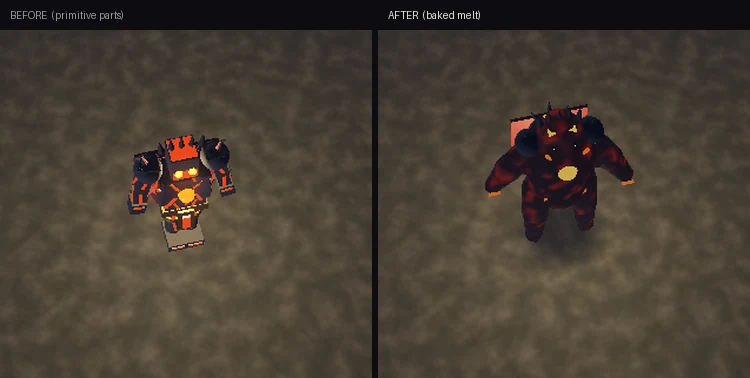
The melted version carries the heat as a mottled ember pattern painted into the mesh, glowing through the darker rock, with the bright lava saved for a few unshaded seams and the chest core. It went from a robot made of hot bricks to something that looks like it cooled from a pour and never finished. The crown, the gold core and the ragged cape stayed as small crisp pieces on top, because those are the details that should stay sharp while the body goes soft.
The casters were the hard part
The newest wing of the bestiary is the undead casters: a phantom scribe, a void caster, a mummy priest, and an elite lich. These were the trickiest conversions so far, because a caster is mostly cloth and a glowing focus, and both of those fight the pipeline in their own way.
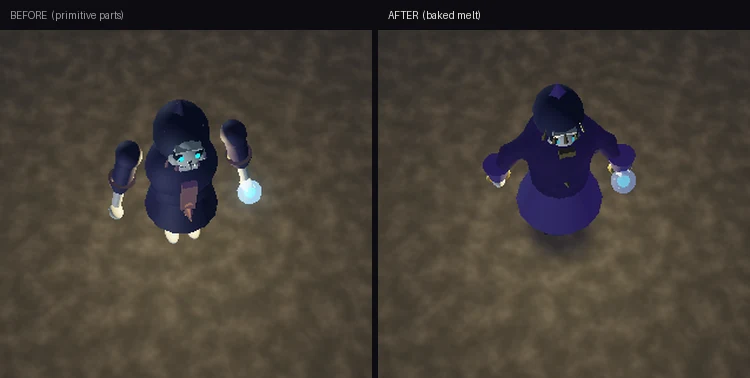
Two problems showed up that a studio render would never have caught, and both only appear once you put the creature under the real torch at the real distance.
The first was color. The baked body holds its color correctly, because the melt shader controls its own shading. The extra cloth pieces, a robe skirt or a hanging hem, are ordinary lit surfaces, and a warm dungeon torch multiplies a deep violet skirt straight into a washed-out pink. On the first pass every robe looked like it had been through a hot wash. The fix was to give those cloth pieces a faint self-glow of their own color, so the torch can add warmth on top without dragging the base down to pink. Now the robes read as robes, and the hems carry a low arcane shimmer that actually suits a caster.
The second was faces. From a top-down camera you are looking at the tops of heads, and a deep hood shades exactly the part you want to see. The void caster lost its glowing eyes entirely, swallowed by its own cowl. The scribe and the lich hide skull faces in there too. The answer was to push the face forward until it clears the hood brim, so the eyes catch the light from above instead of hiding under it. A small move, and it's the whole difference between a menacing hooded skull and a black blob with a hat.
The sun-hat mummy
The mummy priest is my favorite story from this batch, because it's a clean example of where a person still has to make the call.
The first melted mummy was technically fine. Wrapped linen body, pharaonic collar, a blue-and-gold headdress, glowing eyes in the wrappings. Every piece was where it should be. And it looked like a man wearing a floppy sun hat. The headdress was a smooth rounded dome, and a smooth rounded dome on a head reads as beach vacation. This is a creature that has spent a thousand years sealed in a tomb.
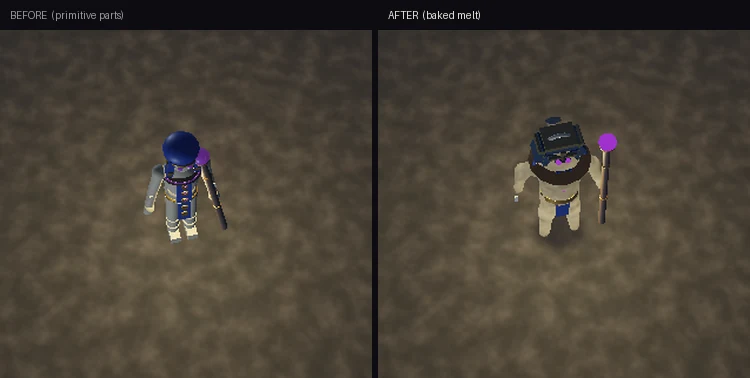
The redesign kept the pharaonic idea and threw out the dome. The new headdress is a flat, low, angular slab that flares into squared cloth wings above the shoulders, hangs striped lappets down beside the face that tear off ragged at the tips, and gathers into a tail down the back. The blue is dusty and faded, the gold is tarnished, and the linen carries a cloth grain so it reads as centuries-old fabric. Same silhouette family a real Egyptian priest would wear, aged into something that belongs in a crypt.
Nothing about the first version was a bug. A test would have passed it. It took a person looking at the render and saying the words "that is a sun hat" for it to get fixed. That is the part of this work I have not handed to the machine and do not expect to. The model builds the volume, wires the pieces, and reads its own renders well enough to catch a floating eye or a clipping shadow. Deciding that a headdress reads as leisurewear is taste, and taste is still a chair with a human in it.
Where it stands
The heroes, the flyers, the fungal monsters, the fire cohort and now the casters are converted and in the game, each one held up against its old version at this exact camera until the new one clearly won. Everything ships behind the same boring guardrails as before: a triangle-budget test that fails any creature over the ceiling, both test suites kept green, and a performance probe that will not let a floor of monsters blow the frame budget on a phone. A few dozen creatures down, a handful to go.
If you played an earlier build, the monsters you fought are the ones on the left of these comparisons. The ones on the right are what is in the dungeon now. The demo is live and free in the browser. Go find the mummy and tell me the hat looks better.