
Cosmic: Alliance, the game I kept waiting to be able to make
· 11 min read
By Phil · building Legitsauce
I have had a game in my head for a long time that asks considerably more of the graphics than anything else I have tried to build.
It is called Cosmic: Alliance, a space exploration and survival game in which you come face to face with a celestial being three suns wide. You play Captain Aelar aboard the Concordance, working alongside an unfamiliar crew and traveling far enough from home that the things you discover begin to exceed your ability to explain them. I want the first encounter to leave you staring at the screen for a moment before you remember you have a decision to make.
That is a difficult feeling to sell with a rough character standing in a room full of placeholders. The game I have imagined depends on sweeping cinematics and graphics that can survive a long, deliberate look. A face has to hold your attention through a conversation. A ship has to feel inhabited before you become afraid of losing it. The AAA ambition has been there for years. Getting the 3D work anywhere near it has been the recurring problem.
So I put Astra to the test. I gave it the story, the visual direction and an increasingly demanding list of things to build. To my eye, it came very close to making that larger idea feel achievable, significantly closer than any of my previous attempts. There is still a visible distance to cover, especially in the characters, but I finally have enough of the game in front of me to show you where it is going.
A ship worth coming home in
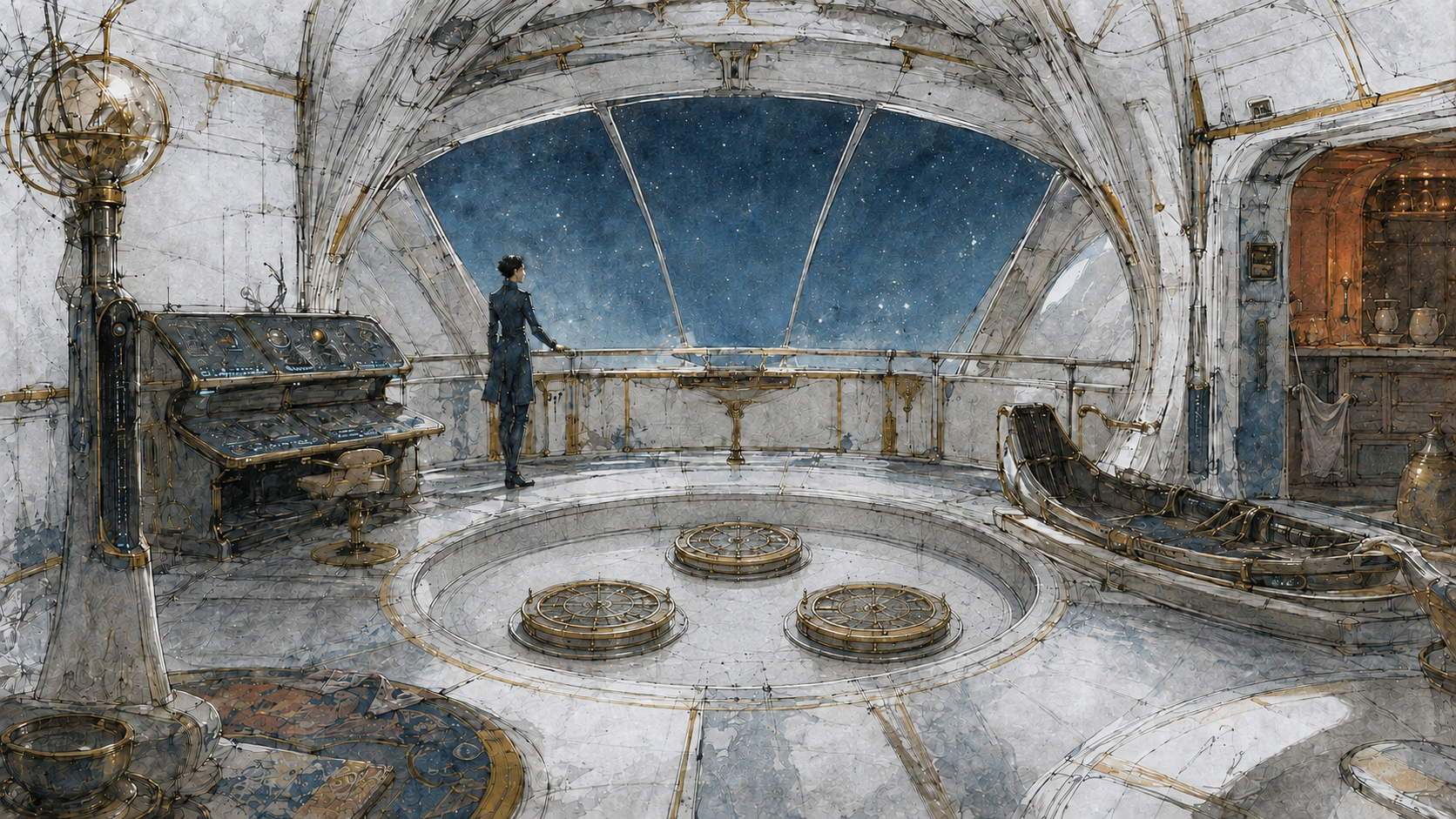
The visual work began with concept art for the crew and the places they inhabit. I wanted the Concordance to have a sense of age and care: pale surfaces, dark uniforms, brass instruments, a wide observation window and equipment that looks as though somebody knows how to repair it.
The galley matters just as much to me. There are five cups on the table because five people belong there, even when their bodies and habits have very little in common. Aelar carries familiar things into an unfamiliar part of space. I want you to remember her preparing a drink when you later see her make a decision that could cost the crew their way home.
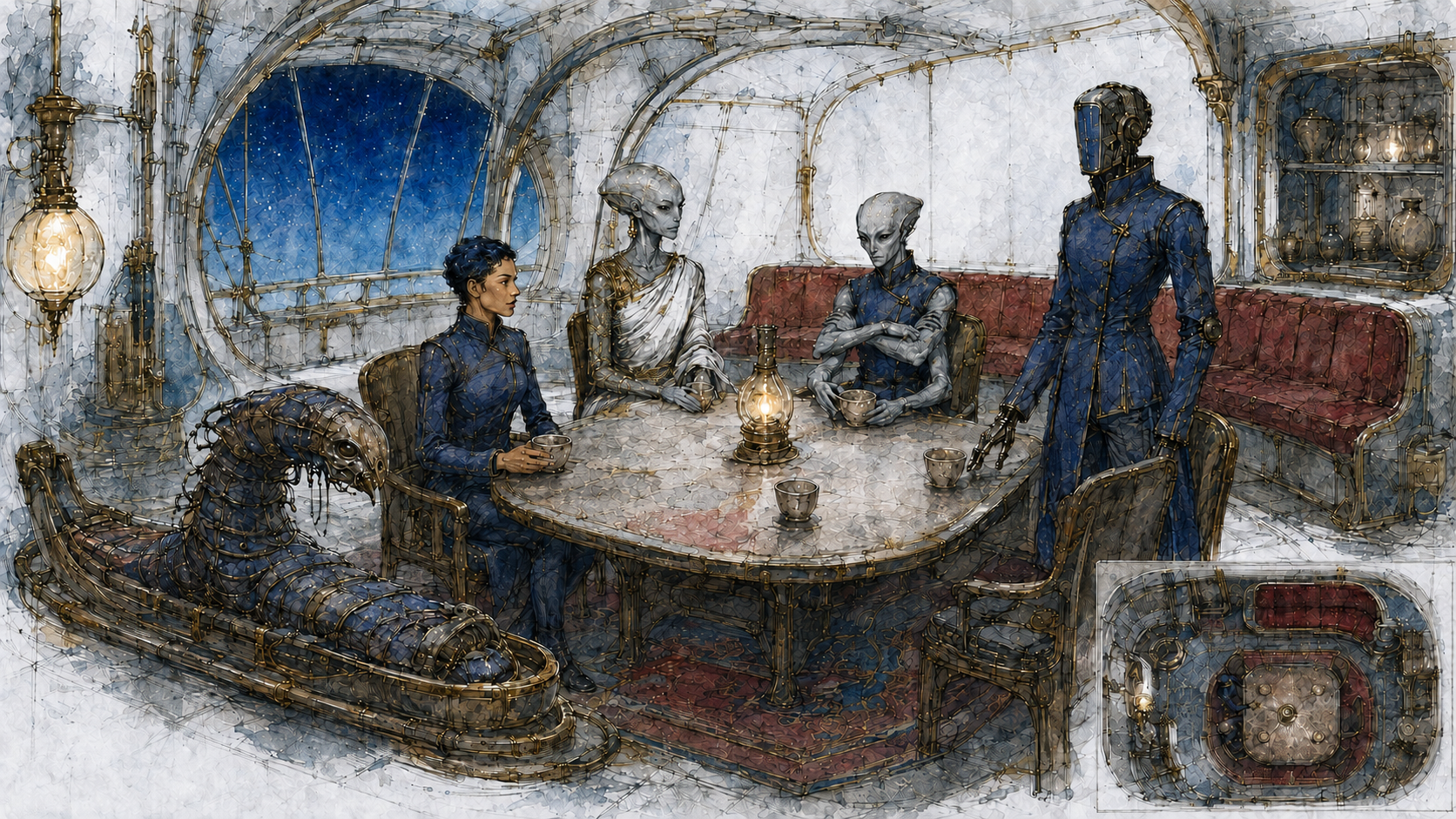
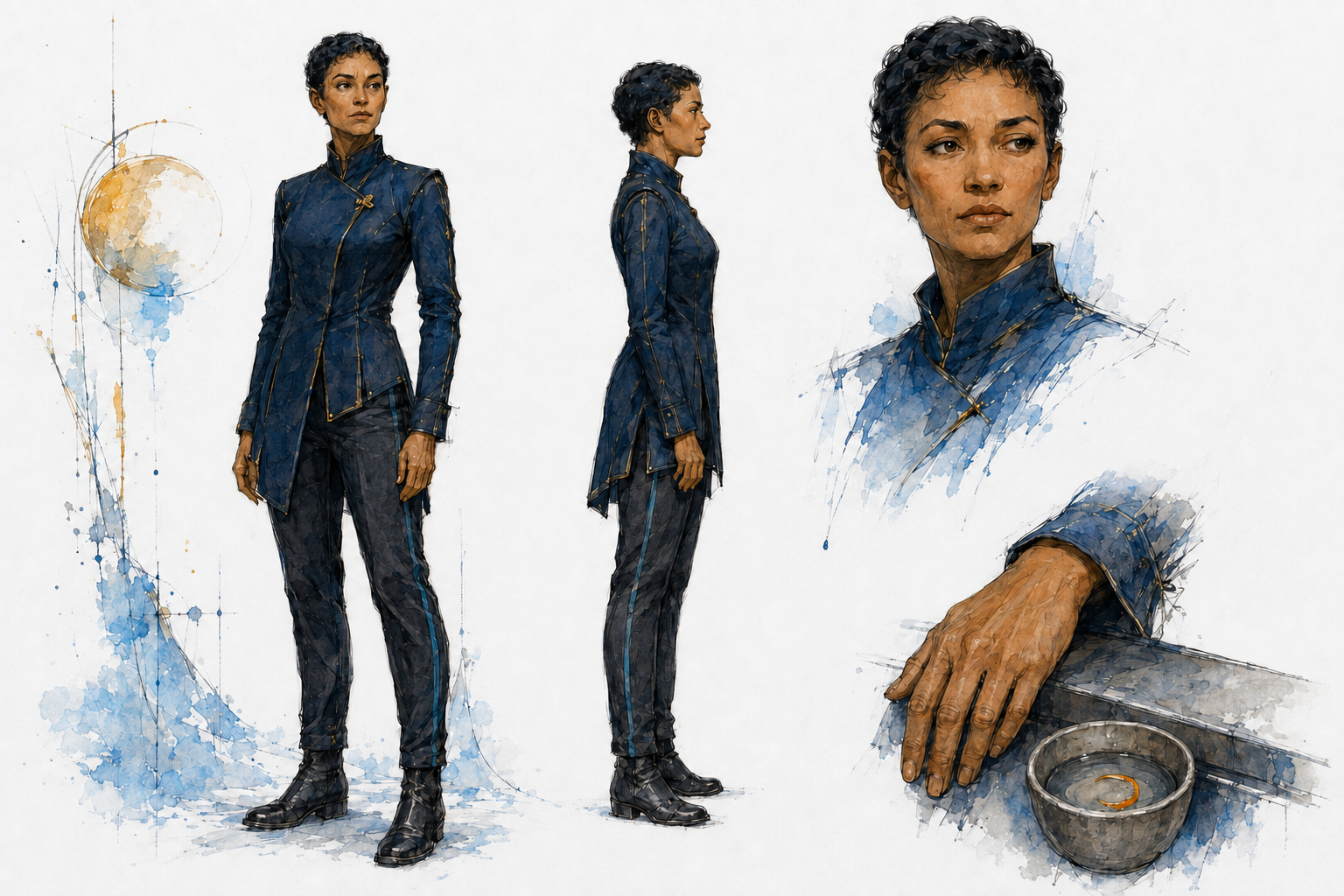
These are illustrated targets for the game. Their loose lines and painted textures establish the characters, architecture and mood. Translating those decisions into a realistic, moving scene is the job that follows. I want to preserve the warmth and specificity of the drawings as the materials become more convincing.
The first few minutes
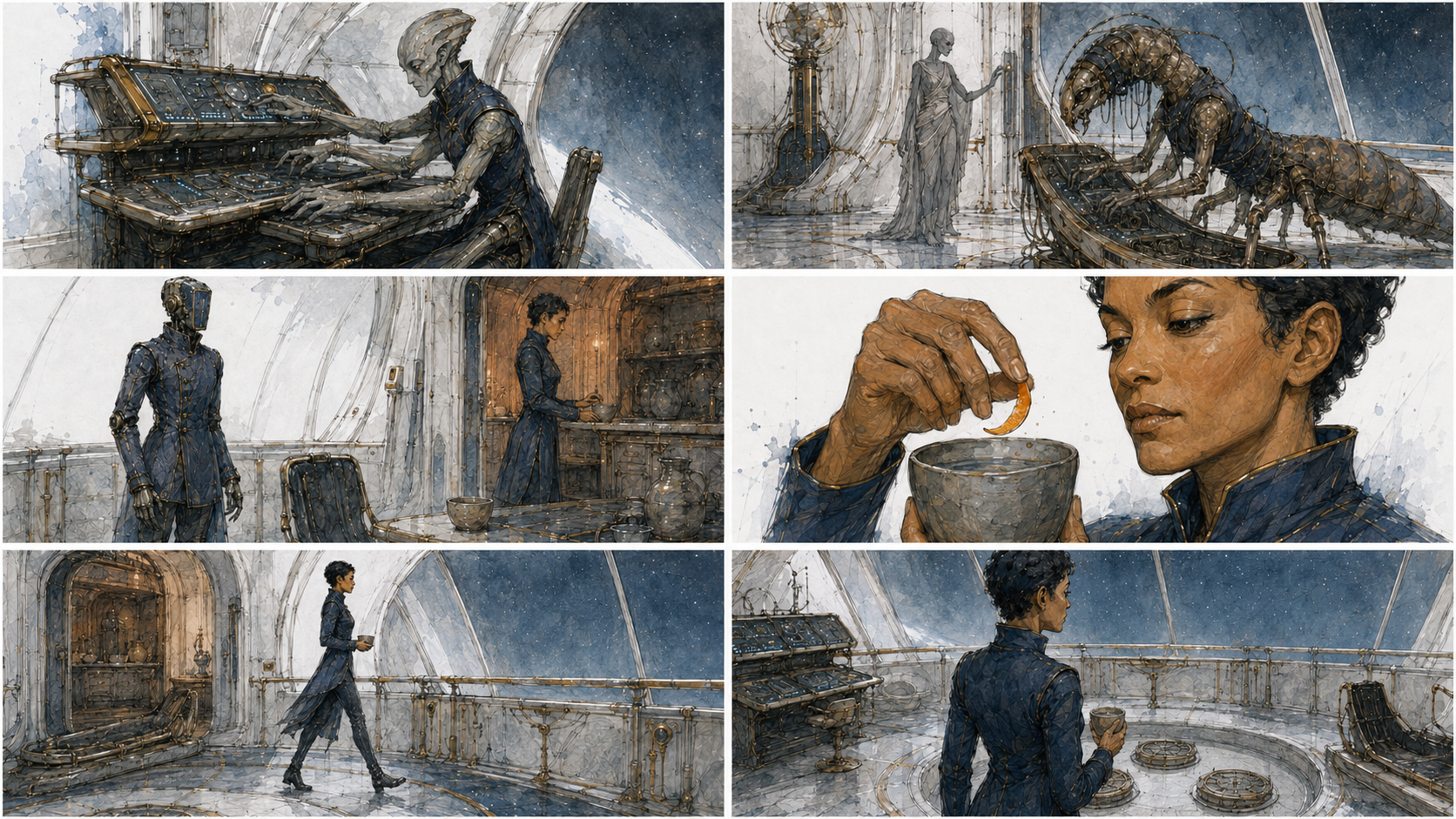
Before building out the demo, we storyboarded its opening stretch. I wanted time to meet the crew at work and understand what an ordinary watch feels like aboard this ship. That gives the first disturbance something to interrupt.
The next board moves from that routine into observation. Aelar approaches Soren-Kai's station, studies a comparison and listens. The intended gameplay is simple enough to follow without breaking the scene's rhythm: walk to a station, examine what the crew has found, make the next call.
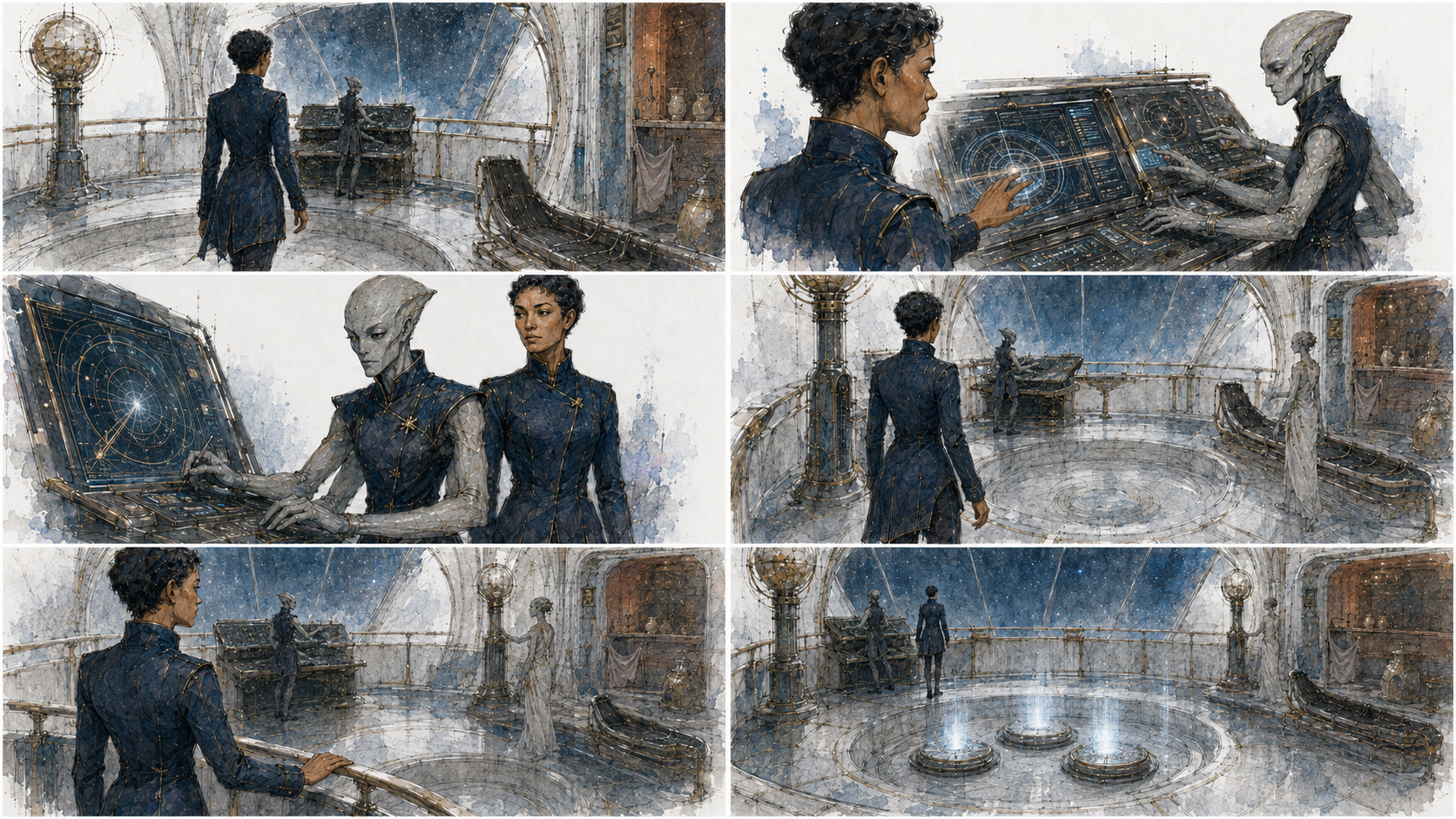
Those small actions set the pace I want. Exploration should leave room for looking. Conversations should give the crew time to become people you recognize. I want to be able to hold a wide shot without the player impatiently waiting for the next prompt.
I am keeping the celestial being out of this first look. The ship and its crew can introduce the game. That encounter deserves its own reveal.
How I got here, one awkward monster at a time
If you have followed the making of Crawl of the Forsaken, you have already seen an earlier version of this problem. A 3D dungeon crawler needs a lot of creatures, and I needed a way to make them without turning every monster into a separate, lengthy art project.
Procedural generation gave me an answer I could actually ship. The creatures were assembled from boxes, capsules, ellipsoids and other shapes described in code. That made them small to download and quick to revise. It also made their construction obvious. A leg could look like a capsule pushed into a larger capsule. At the right distance the creature read well enough; bring the camera closer and you could count the pieces.
Along the way, I tried Blender MCP, letting an AI agent operate the modeling tools, and experimented with Meshy.ai. Across these attempts, screenshots became part of the process. The AI would build or import something, render it, inspect the result and make another pass. I kept pushing on proportions, surfaces and whether the model still looked right from another angle.
Each approach produced useful work. None reached my threshold of "good enough" for a high-end cinematic game: consistently good models, convincing skins and a body that deforms properly when it moves. A model could be promising in one image and disappointing as soon as it moved. Getting an asset into the engine was often much easier than getting it to belong there.
The next substantial improvement was the melted-monster pipeline in Crawl of the Forsaken. We described a creature as a continuous volume, blending the component shapes together before turning that volume into a mesh. Limbs could flow into a torso. Light could travel across a connected body. The creatures gained a surface that made sense as skin.
That process had its own habits. Small features could disappear into the blend. Feet could become stumps. Cloth tended to soften in places where I wanted a definite edge. I got better results, and I also got a clearer understanding of what I was asking the method to do.
In the follow-up about the real gameplay camera, the lighting and viewing angle exposed problems the studio renders had missed. Eyes vanished under hoods. Robes changed color under the dungeon lights. A mummy's headdress looked like a sun hat. That last one remains a useful reminder: a model can have every requested component and still make the wrong impression.
The repeated lesson was to keep looking at the actual game. Screenshots gave the AI a way to catch its own mistakes, and they gave me something concrete to judge. I had made real progress on the dungeon's creatures. I still wanted faces and clothing that could withstand the much closer camera in Cosmic: Alliance.
What I asked Astra to take on
For this project, Astra handled the entire 3D production pass. It created and assembled the environment, models, rigging, textures and materials using Blender as its main authoring tool, then integrated the assets into the playable scene. Astra wrote and ran the Blender scripts, exported the assets, put them into Godot, took screenshots and revised what it saw. I supplied the direction and kept asking for another pass where the result missed it.
Aelar starts from CC0 MakeHuman base geometry, rig data and skin inputs, which Astra adapted in Blender alongside the costume and groom it authored. Some material images and the concept art came from image generation; further surface treatment and lighting happen in Godot. Those sources deserve credit. Astra's part was to take the available ingredients, author the missing pieces and make them function together in the game.
The bridge became a navigable 3D environment with modeled architecture and instruments. The crew gained distinct bodies and working positions. Aelar gained a deforming body and facial rig, clothing, hair, materials and a set of actions for moving around the ship. There were actual objects to inspect, turn around and put under different lights.
The screenshot loop stayed central, and the problems became quite specific. The hair initially sat above the scalp and had to be fitted to the head. The coat needed a continuous shape to stop its pieces intersecting. We checked the collar, sleeves and boots from several angles, then checked the clothing again through the action set. The following render showed whether a fix held or had moved the problem somewhere else.
That is a more demanding assignment than making a single attractive still. The same character has to remain recognizable while walking, turning, speaking and standing beside another crew member. Her clothes have to keep their shape through those movements. The lighting has to reveal enough detail for a close shot without making the bridge look as though it belongs to a different game.
Aelar, from the drawing to the engine
Here is the comparison I keep returning to. On the left is Aelar's approved concept art. On the right is the current 3D model, captured in Godot. Both views are cropped for this layout; the links open the complete images.
Concept art
3D model
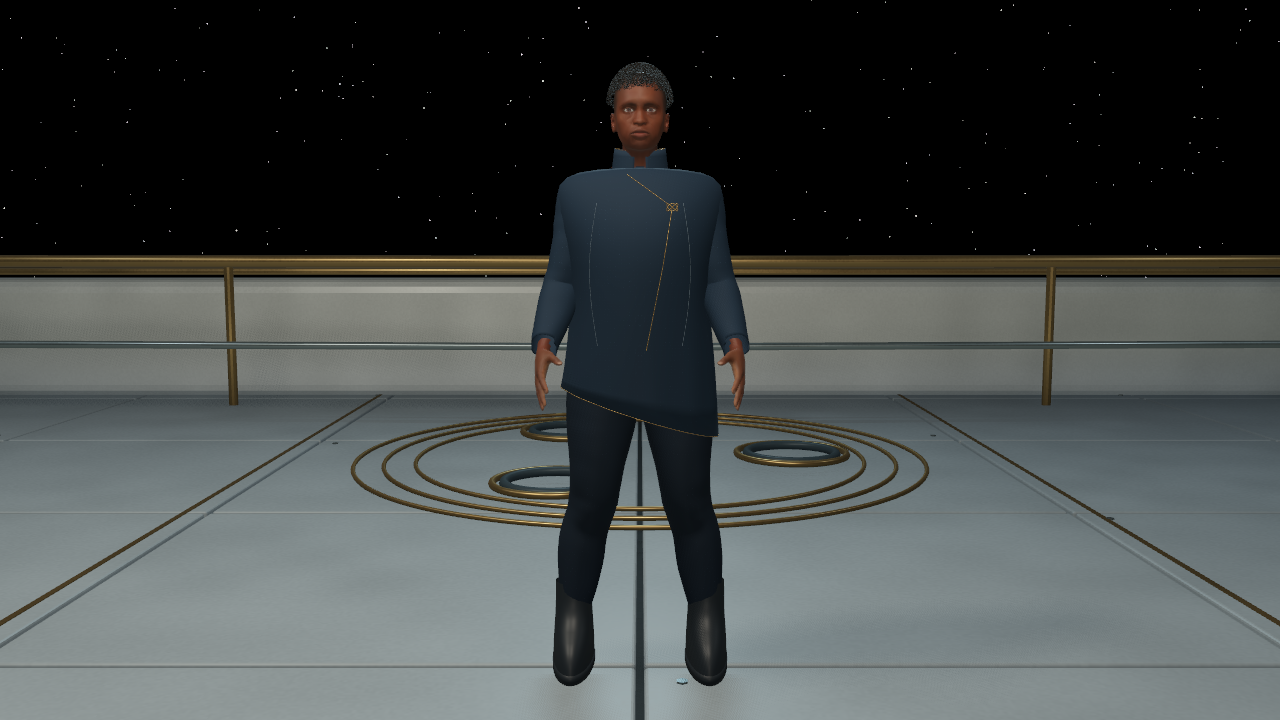
The navy silhouette, asymmetric closure, high collar and restrained gold detail are making the transition. The face and cloth show how much work remains. The drawing has age, character and a delicacy in the material that the model does not yet carry. I want those qualities to survive the move into 3D.
Even with that gap visible, this has come significantly closer to my goal than the earlier attempts. The progress is in the assembled scene as well as the individual asset: a character with a working rig, wearing a specific costume, moving through a ship built for the story. I can now refine the same scene I intend a player to inhabit.
The latest pass stages an exchange between Aelar and Kraz at the command station. It brings the camera onto the speaker, lights the face and keeps the dialogue clear of the characters. Reviewing it caught a backwards-facing crew member and a camera handoff that needed fixing. Those are mundane details, but a cinematic scene depends on getting them right. Voice performances are still to come; the current voice slots are intentionally silent.
The game beyond the graphics test
Cosmic: Alliance is being built around exploration, survival and responsibility for the people aboard your ship. I want the controls to stay approachable so there is room to absorb what is happening. You observe with your crew, give orders and decide how to act on incomplete knowledge. The cinematics carry scale and atmosphere; the decisions have to carry consequences.
The demo is planned around the opening half hour and two possible ending routes. That gives us a manageable stretch of the game in which to prove the pacing, the characters and whether a choice feels worth thinking about. The playable version is still compressed. A working route through the events is the beginning of that process, and there is more to do before it sustains the experience I have in mind.
The next work is to bring the character detail, performances and remaining scenes up together, then play through the whole thing and find the moments that still feel unfinished. I want to watch someone meet this crew for the first time and find out whether they linger at the window, listen to the conversation and hesitate over the decision. That will tell me more than another isolated render.
For now, you have met the captain and seen a little of her ship. Somewhere beyond that window is the encounter I have wanted to build for years. I am finally getting close enough to start showing you the journey there.