
Coming soon: Inkborne, interactive novels you can play in bed
· 7 min read
By Phil · building Legitsauce
Most of what I write about here is small, fast browser games, the kind you open for two minutes on a train. This is the opposite of that. For a while now I've been building a second thing on the side, and it's finally far enough along to show. It's called Inkborne, and it's a platform for interactive novels: stories you read, that read themselves to you, and that you steer at the moments that matter.
Think of the last good book you read in bed, and the last good game you played on your phone. Inkborne is my attempt to put those two things in the same place.
What Inkborne actually is
Under the hood, every Inkborne story is written in Ink, the open scripting language Inkle built for their own games. Ink is wonderful for branching narrative. It is also, on its own, just text and logic. Everything that makes Inkborne feel like a finished thing sits in the layer I wrote on top of it: the word-by-word reveal, the voice narration timing, the backdrops and silhouettes that fade in behind the prose, the sound design, the little mini-games that break up the reading. Ink decides where the story can go. The custom code decides how it feels while you're there.
The reading experience is the part I care about most. Text fades in one word at a time, paced slightly ahead of the narrator's voice, so it feels like the words are arriving as they're spoken rather than dumping a wall of paragraph on you. The story keeps moving on its own until it reaches a decision. You don't hammer a Continue button. You just watch and listen, and every so often the world stops and asks you to choose.
Made for reading flat on your back
Here is the design constraint I kept coming back to. I wanted something you could genuinely play while lying in bed, half asleep, holding the phone over your face with one hand.
That sounds like a joke, but it drove a lot of real decisions. The story auto-advances, so you are not tapping every few seconds. The narration carries the scene, so you can let your eyes close for a stretch and still follow what's happening. When a choice does come up, the touch targets are big and few, sized for a thumb and not a stylus. There is no twitchy timing you'll fumble when you're tired. It is built to be comfortable in the exact posture where most people actually have a free thirty minutes, which is flat, in the dark, at the end of the day.
Mobile-friendly gets thrown around a lot and usually just means the buttons don't fall off the screen. I mean something more specific here. Inkborne is shaped around the way people actually hold a phone when they finally have time to themselves.
The first story: Ka'Zhurn: Soil and Blood
The launch story is one I wrote myself, under the pen name Glen Ember, with editing passes done alongside Claude Opus 4.8. It's the first book of a planned trilogy.
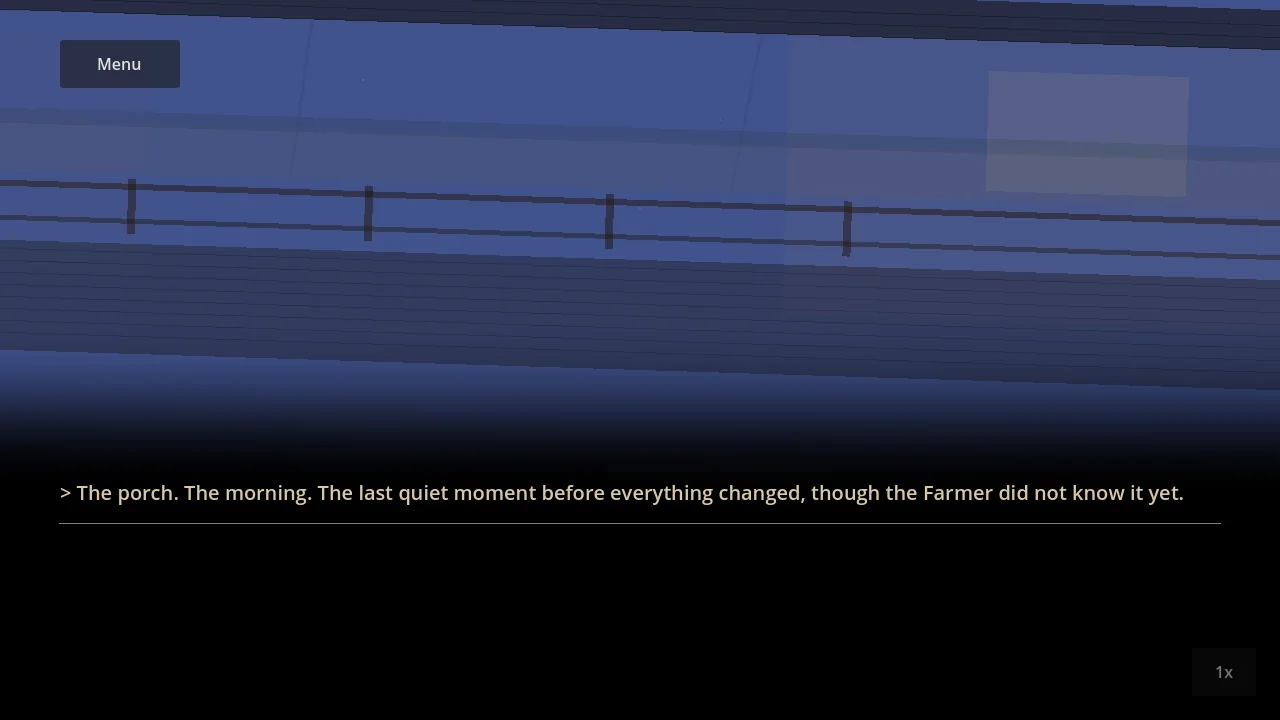
It opens on a farmer and an ordinary morning. He leans on his porch rail, lets the sunrise warm his face, and for a few pages nothing is wrong at all. Then there is smoke on the horizon that has no business being there, and by the time he understands what's coming, the question in front of him has stopped being about his crops or his roof. It becomes about his family, and about what a quiet man is willing to turn into when everything he loves is suddenly on the table. The thing arriving at the edge of his village is older than the village. People stopped saying its name out loud a long time ago.
I'll leave the plot there, because the turns are the whole point. What I can show you is the opening beat, the calm before any of it: the porch, the morning, the last quiet moment before everything changes.
How the art gets made
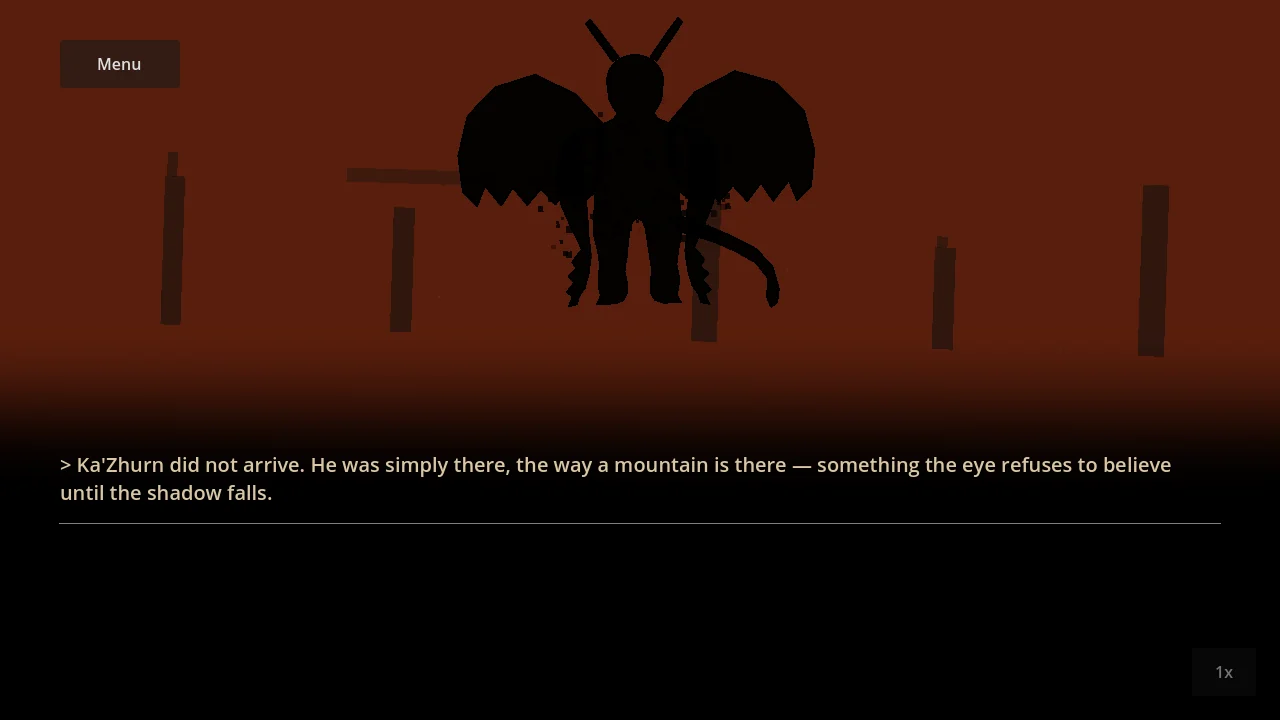
The look is deliberately spare. Backdrops are simple, moody, and built to sit behind text without fighting it for attention. The figures that matter show up as silhouettes that coalesce out of a particle field and then hold while the scene plays.
Those silhouettes start as my own drawings. I draw the figure by hand, then I trace it into clean vector shapes with Claude Opus 4.8, which is genuinely good at taking a rough sketch and giving me back the exact outline I was after. Ka'Zhurn himself went through that process. The broken-winged shape you see below began as a drawing on my desk and ended as the vector silhouette that looms over the village when he arrives.
It's a workflow I'm honestly really happy with. I keep the part that's mine, which is the drawing and the intent, and I hand off the fiddly vector cleanup that I'd otherwise spend an evening on.
Sound and voice
Sound carries a story like this as much as the prose does. The effects come from two places. A lot of them I pull from OpenSound.org, and the rest I generate with AI audio tools when I need something specific that no library has, like the exact quality of a breath in armor or a wall of force going through a barricade.
Every line in the game is narrated. The voices run through a blend of ElevenLabs and Chatterbox, the open voice model from Resemble AI, and a few characters are voiced by me directly when I want a specific human read that the models don't quite land. After that, all of it gets hand edited in Audacity, take by take, until the timing sits right against the text. When a scene needs music, I build that in FL Studio.
None of this is "press a button and out comes a game." Every voice take gets listened to and trimmed. Every effect gets placed by hand. The tools speed up the grunt work so I can spend the time on the parts that actually decide whether a scene lands.
The part that stays mine
I want to be clear about one thing. The story, the direction, the pacing, the whole feel of it, all of that is mine. The tools let one person reach further than one person usually can, but they never decide what the game is about. I wrote Ka'Zhurn because I wanted to read it, and I built Inkborne because the story deserved somewhere that did it justice.
When and where
Ka'Zhurn: Soil and Blood is still in progress. It is playable end to end in a rough form, and now the work is in the polish: the voice editing, the sound placement, the art passes. It's headed for phones first, since that's what it was built for, with a desktop version close behind.
I'll keep posting progress here as it firms up, including the messier behind-the-scenes stuff that I find more interesting than any trailer. If quiet, sad, beautifully read stories you can play with one thumb sound like your kind of thing, this one is being made for you. More soon.